Strangers in My Commute

I would call myself an observer. A passive observer. I watch people. I judge them in my heart. And most days than not, I feel deep sympathy for strangers. I like to narrate their life in my head. Like talking in their voice as they walk in front of me while we share the air. Providing a voice over their heads while I'm sitting on the train like now. 

The sun is golden at this hour. The rays are closer to orange than red. Oftentimes, I'd romanticize life when the sky is looking this clear and the sun is being nice like this.

A guy standing in front of me is wearing a neat white shirt and navy pants. His bag looks heavy. He must be carrying a laptop inside. Could he be an insurance agent who just  convinced a retired teacher to renew her policies? But then what is the story behind those two lines between his brows? A stress? A loud thoughts? Oh maybe he’s an over thinker who thinks that when people are whispering near him they are probably talking about the way he talks. He looks like a Rico. Yes. Let’s name him Rico. Rico might not be aware of this, but he’s a lucky guy with a nicely shaped forehead. It’s rare for a guy to have that shape that compliments their look.

I shift my gaze towards the girl standing in front of the train door. She has big headphones on. Like the size of each pad is probably one fourth the size of her head. She nods in rhythm. I look over her feet. She’s tapping it. The parachute trousers she’s wearing have an extra pocket behind the knee fold. She probably is a customer service agent working for a company that makes their way around to not give an increment this year. The girl looks like the name “Sandra” fits her. Sandra probably reads books. Maybe two books in a year because during her commute she decides to scroll on tiktok. The way her shoulder is looking tense makes me think of a financial struggle she carries. Oh. To be young and trapped in the system!

I sigh. Give my eyes a break and watch the city line moving on the window. I love to imagine how the train is standing still and the world around it is the one that’s moving. The sun has gone lower. The cumulonimbus visible behind the buildings is now grazed with thick orange that looks like the margin of a bonfire sight. 

I visualize a string of light popping from on top of my head and connecting me to Sandra. “Sometimes you may envy people for not having money problems. Some of those people, well, they envy you for having money as your only problem. Remember that.” I whisper in my mind. Hoping that the string of light can relay the message to Sandra. 

The train door opens. This is my stop. I close my note book where I jot down the observations and walk outside. I put my ear pod in to drown the thought that I have, that my observer could not guess.
A Dreamer’s Dream for A Dream

I’m a dreamer. Not the kind where I have a dream to build a house where I can put all my family in one place—so that I don’t have to take a flight just to spend a few days with them. I’m a dreamer in the sense that when I go to sleep, my mind will start presenting bits and pieces of my life into a sequence and roll them with some editing and choices of genre. That kind of dream. 

I had all kinds of dreams; One night, I was dreaming about a cooking school that got bombed (I can’t really tell this one now because of The Last Harvest). I wrote it down in my dream journal. A few months later, I wrote an opening scene for that dream in a first person POV. I wrote it down with a mechanical pencil I just bought, in a notebook  I felt like I don’t really like. So once I finished writing–probably got distracted and forgot what I was doing–and put the book down, I forgot about it until last year. That’s when I realize that this could be something, and that the story is too big to be abandoned and not being loud about. 

Now I’m dreaming of making this dream into a book. I got a hundred and fifty pages in the draft now. And I’m so proud of it. But that is not the reason why I write this piece. I want to tell a story, about a story, that teaches me about some lesson.

Lesson Number 1

So the world has been crazy since the beginning of 2026 if not since the last decades. I think we as human beings, collectively are experiencing–what I would call–an unfriendly weather inside our head. Well, let me just speak for myself. I’ll rephrase that: I have been experiencing dark clouds inside my head for quite a while. And for some reason, I tend to forget that my soul needs something to channel the anger, the grief and everything else into. Which in my case, writing. 

When I started working on The Last Harvest, the cloud in my head started getting thinner and a little bit of light started creeping in. It's not so dark nowadays. It’s not like the storm is brewing inside it anymore. So writing, as I knew before, and had to relearn the hard way, is the simple and cheap cure. It’s a tool. To get through commuting without breaking any windows. To get through the day without screaming good profanities to strangers on the side walk. To get through the week without feeling the pull to find the lake where all the poets went to die. 

The lesson mostly is for me though. Maybe it can work for someone else too. If writing is not your cup of tea, just believe me when I say that it works all the same with whatever your tea is. Simply put, art is the way.

Lesson Number 2

I find myself rushing in everything that I do. I rush myself leaving the bed when I wake up. I rush myself to make coffee in the morning to jump start the routines.  I rush producing my words when I talk. Sometimes it makes me sound blubbering. I rush at everything I know that it’s not healthy. My nerves must’ve been fried by now. I don’t know.

But this rushing tendency is not only for physical activities or routines. I tend to rush my stories as well. Like when I start something, I find that I can’t wait for the end product. It makes me want to do things quickly, so I abandoned the development. Most of the time. This is one of the reasons why I can never finish a whole story without getting distracted on doing another piece. I just can’t wait. 

The Last Harvest is different. Maybe because I love the character so much I don’t want to ruin their arc. Maybe the story is so dear to my heart I want it to be good so that I start taking my time. I enjoy the process more. I take my reading sessions about corn as the process of writing. When I watch the storm from my apartment window and internalize the spit of rain touching the glass, I take it as a writing process too. When I mindfully sit and listen to my loved ones talking, I call it a writing process too. 

The Last Harvest, my third baby, taught me something important. That writing is not all about sitting and running my fingers over the keyboard to produce ten thousands of words into pages. Writing is me. When I wake up every morning and think about Suri and her sketches, it’s writing. When I put my head on the pillow and try to sleep and the voice of Alex plays in my head, it’s writing too. Taking notes of my friend Daniel’s insights and jokes is also part of the process. 

Patience, taking time, and enjoying the process, is what I believe will make The Last Harvest Better than anything I’ve ever written.

Lesson Number 3

In between my work days and the weekend, last week, I made time to listen to a podcast of a friend. A podcast where he narrates my poems and prose. It has been years since the last time I heard or read the piece. So when I heard Reza Romano pronounce every word from my poem with a little bit of music in the background, I found myself crying. I thought to myself “who wrote that?” Because it sounds so beautiful and honest. And then I remember how I felt when I wrote the words, I wasn’t proud of what I made. I thought it was a mediocre line of yearning. But after spending years away from it, I can see it from afar and remove the criticism in my head when I listen to it, from someone else’s mouth. 

The lesson was, we, I, can be the worst critics of our own creation. We think we can judge and look for the worst part of something, because we think we’re not hurting ourselves in the process. We’re not being fair to ourselves about our creation. Most of the time. At least in my case. 

With The Last Harvest, I try to just pour myself into the pages. I just write everything as honestly as I can and not reread everything before I put myself away for sometime. The Last Harvest, as important as it is to me, taught me that to give birth to a good piece of art, I need to separate the editor and the writer in my head. They each can have their own time to be activated. 

I wrote this for me. For someone like me, who happens to find this page in the middle of a struggle making their dream come true. For someone looking for a way to bring their imagination bleeding their way into our world. So that we remember, it’s not just about the end product, it’s about the process and what it taught you. Us.

The Songs That Raised Me Still Know How to Comfort Me

Have you ever felt a choke in your throat that can only be relieved by warm drops falling from the corner of your eyes? Or do you ever experience the big lump burning inside your chest but instead of hurting, it makes your whole body feel like in that strange, graceful trance nostalgia brings?

When I decided to sit down and write this, I had this overwhelmingly good–nostalgic–warm feeling that resulted in tears shed. Not once, not twice. 

Before bed, I was humming a tune and started singing, “Susan… Susan… Besok gede mau jadi apa…” and had this serious will to find the whole discography of Kak Ria Enes and Susan on music streaming platforms. I was so absurdly happy when I found Kak Ria Enes and Susan on Apple music.  So then I decided to listen to my favorite song, Susan Masuk Sekolah before really trying to sleep. 

Let me take you back to 12 hours before this morning (when I wrote this). 

I didn’t expect that the first tune of that song would make me cry. The kind of cry that you don’t understand why. The kind of cry that makes your heart filled with this happiness but it feels far away. The kind that makes you feel full, but empty. The kind that makes you long for something, but you just couldn’t point out what specific thing is that longing for. 

And then I was like, okay, maybe I’m in quite a hormonal imbalance and decided to listen to Kak Ria and Susan when I’m in a good state. I betrayed that commitment because on my way to work this morning, I listened to them. The whole Volume 3 and Susan Masuk Sekolah album. I knew this would put a lump in my throat and choke me with these feelings that I think I’m familiar with but not sure how to handle without crying like a baby.

I was probably around 2-3 years old when I first listened to Kak Ria Enes and Susan. I kept getting back to the old blue cassette when I was 5 to 7 years old. I remember how me and my older brother would sit around our old fading black Polytron  tape player to listen to it and dance to Si Monod song. 

But returning to it at 32, on a bus to work, felt different. And I’m not sure if this will work the same way with other 90s kids, but for me, my Susan moment was so therapeutic in the most nostalgic way. It lights up my drained exhausted soul. It sparks my sleeping hope back to life. It gives me this euphoric feeling because I smiled from ear to ear from the lyrics and Susan’s behavior. It makes me feel calm through Kak Ria’s soothing voice. 

And then when I stopped, it brings me to this conclusion:

Listening to your childhood songs as an adult is another way to get in touch with your inner child. And when you can make a good reflection while in that state, you heal another part of that scared little kid inside of you. In my case, I get to see something in life, from the perspective of a brave–full of energy–little me. At least for the whole duration of  Punya Cita-cita song.

Now I’m about to turn 33 in a week. And I think I will get back to Kak Ria and Susan once in a while for every time I feel like the world has given me too much stuff to think about. Because it will take me back to that time; the time when I don’t really understand how the world works that it makes everything possible in my mind and because of that I get to dream of every little dream I might have without the fear of losing it in a blink of an eye. 

Oh to be a kid and not knowing. To be a kid, and believe that the world is gonna treat you right. To be a kid, and think you’re going to make it when you’re old enough. To be a kid, inside a 33 years old body and still have that faith–that everything is going to work out in my favor.

Callouses on my heart

Unlike the tip of my fingers 

That feels like they burned 

When one or two songs 

Finally sounds like it should 

When I learned 

Neither was the surface of my hand

That gets thicker in places

Some for all those years 

I spent riding a bike

Some for holding on to my pen 

a little too strong 

Ones on my heart

They feel more like a

Blister

And where it came from 

I don't know 

Hard to explain it poetically 

When tragedies and wars

Ignorance and greed 

Grief and humility 

Hunger and broken dreams 

Doesn't sound like a guitar 

And doesn't taste like good experience 

But they do

Make a loud mark


-Suci BYT-

June 11th, 2025

The Tax of Getting By: What Does a Flawed World Demand of Us?

What is the cost of living in a world with a faulty system?

Sanity? If that's the price, no wonder you see so many people losing it even before they hit 30.

Kindness? If that's another cost, then it totally clicks why so many folks are being jerks.

Excitement? If that's part of the bill, it explains why I'm losing interest in the little things, like getting hyped about new movies or wanting to go do stuff outside.

This is why an extra day off for the weekend like today is so precious to me. Because I get to be away from the crazies outside. I get to be away from having to deal with mean people all over the town, and I get to be on my own in my own place, doing the thing that I want to be doing but never really have time to do.

Gosh, did I just take a super long break from writing, like actually sit my ass down to rant about something in the forms of written words? And what does it take for me to really start writing again? Weeks of being exhausted with so many questions that need to be answered?

Here's some serious questions: aren't all of you starting to feel it? The exhaustion that you can't understand, and when you try to fix it, you can't even figure out where that came from? Is it physical? Or is it what's in your mind?

Those people who party all the time, who have all the energy to hang out and talk to people, who travel a lot, who go to the mall every day, who—I don't know, everything that you do that I don't—aren't you tired?

And if you don't, please tell me how you do that, because man, I have been tired for the last couple of months, and I don't know if traveling or a full day spa could fix it.

It's 2025, and the unsettling truth is that many of us feel the world is designed to set us up to fail, leaving us drained and too exhausted to pursue anything beyond basic survival. This feeling is starkly illustrated by the limited time we actually have. Consider this: a 40-hour work week, combined with a daily one-hour commute and seven hours of sleep, leaves only eight hours. Subtract another hour for meals and an hour for essential personal care, and we're down to six. Within that six-hour window, we must still find time to connect with loved ones, maintain our homes, prepare food, and handle other necessities, leaving, at best, a mere four hours for ourselves.

Some people can use that 4 hours to go to the gym, to run, to prepare healthier food, to make art, to do a community-based project, to plan a trip, to hang out with their friends, to go above and beyond to find a place to be in nature, or even to do a side hustle. And for that, I really have a genuine and humble question: how do you do that? How do you have all that energy?

Because in my case, I keep dreaming of living in a remote place, owning a huge land to just farm and grow my own food far from the city, far from the world, so I can live in a hush, without all the rush. And if I'm the only one that feels this way, I refuse to believe that it's a me problem because there must have been something that I have been missing about the secret of going through everything in the world that is controlled by the people who ruin everything.

So, tell me, if there's a way to shake off this perpetual exhaustion, I'm all ears. Because how can one truly feel vibrant and alive when the world stage is riddled with conflict? How can one feel at peace while navigating a capitalist system that constantly whispers of inadequacy and the threat of being swept under?

But if it's not just me, then maybe I have something to say about this being totally wiped out —God, I just want to sleep —state. Because if we can't force ourselves to have that energy those party people or gym buddies have, we can just be couch potatoes and rot in bed if we want.

If we don't have the time to make our art, if we can't get ourselves to run or cook a healthy meal, we can just order takeout and count our usual steps as our exercise. If we feel like we don't want to be around people or we just can't stand being in public space because hearing all those noises makes our brain glitching, we can just be in our own space and put on our favorite music—because we still have to go to work to pay those bills that keep going up—while we're out. If we feel like we can only do so much and go so far, then so be it.

Like Katie Gavin said, "some days you do your best, some days you do what gets you out of bed," and I think that sums up everything I've been trying to write and figure out with all these questions.

So What’s Your Tragedy?

Tragedy. When we heard this word, the first image that came to mind probably was a scene of a shipwreck in the middle of a vast ocean swallowing a hundred souls alive. Or just a vivid memory of a massive crack on the town’s road after a deadly earthquake. Some might envision a friend’s grave after a car accident. The list could go on and on to describe what a tragedy could mean to some of us.

The meaning of tragedy is subjective and can vary greatly depending on individual experiences, cultural backgrounds, and philosophical beliefs.

Some of us. Well the rest could probably think of something abstract when we hear the word tragedy. One could think of what a tragedy it was that her dad was born in a poor family that he couldn’t get enough education to take him to be a teacher and ended up being a cop instead, because that was what he could afford at that time while everyone knows that being a teacher seems like his truest calling. Another could have thought about the joyful sound of family laughter at the dinner table when they hear that word but instead are face to face with the senseless empty room full of cold air and stillness because that’s what distance does. Probably when a dog was taught about the word tragedy and heard it for the second time, it probably would imagine chasing a moving tail in the corner of the couch that turned out to be its own. Or for instance, we could think about how messed up it is when the roles of power in some organization, a country even, is filled with people who—if not capable—are just not suitable for the responsibility, the impact could be catastrophic and can cause widespread suffering. And by suffer I mean stress inducing, rage boiling, traumatizing kind of suffering. Tragedy for some is when you did all the work but it’s your bosses taking all the credit with all that annual bonus. What a tragic tragedy.

So if what we are imagining and thinking of when hearing it are variously different, what is the true meaning of a tragedy then? 

Is it when something is supposed to happen but it doesn’t? Is it when what you want is not what you get? Is it when something broke you to the very core of your being that even the beauty of a bedazzled skyscraper couldn’t entertain you anymore? Or is it when you have something so unimaginably dreamy you wish to share it to the whole world but couldn’t because then it would ruin it? Is it something that you know  is so true and to share it can change how the system works but then the external factors get in the way that you might never get the chance to tell the tale?

Oh, to find the definition of tragedy is easy these days. In ancient Greece, tragedy was a ritual performance of the downfall of a great man—usually a king or nobleman— brought low because of some sort of fault. In Psychology, tragedy is defined as an event or sequence of events that can occur singly or collectively resulting in pain and suffering that impact us on so many levels (emotional, social, physical, coping, creative and spiritual).  In the writing world, tragedy is defined as a genre that focuses around a noble character who struggles against strong external challenges.

But, oh, how I forget what I really want to tell you about tragedy in the first place as I start writing about all the things swirling in my brain when I start typing the word and got distracted that I write about all sorts of things before I get to this part where I suppose to tell you what I really want say.

Well, to really define tragedy and understand its meaning is to have multiple layers of understanding and acceptance. Some would say one can only understand tragedy from experience. But I wouldn’t wish any of such to occur in anyone’s life. It’s just when I happen to have some experience with tragedy I just know now that it helped me to be the I am today. In my case and I believe a lot of us out here believe the same; that tragedy is this coarse sandpaper that shapes our edges, tuning it into the fine angle for the perfect curve, the straight line, the pretty outline and perfect footing.


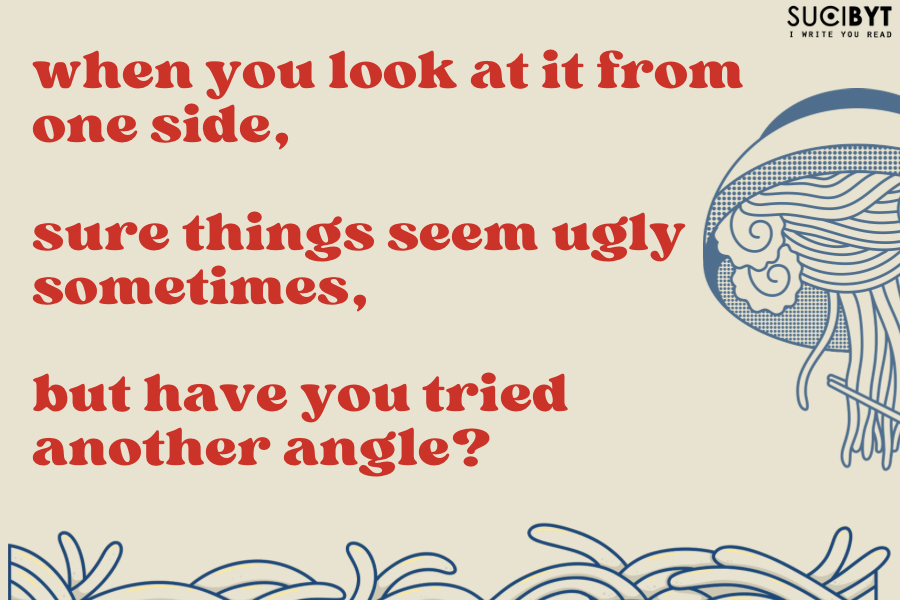
Oh, I really can’t seem to remember what I want to say in the first place talking all about tragedy and  humbly brag that I’ve earned my wisdom to accept the fact that life is a mix of bliss and tragedy, a perfect combination of ups and down, an artistic scramble of good and bad, a collaboration of strength and weakness. But I do remember one part of it. I remember to put this sentence at the end of this short piece; when you look at it from one side, sure things can seem ugly sometimes, but have you tried another angle? You’re welcome!